How to Choose the Best Transfection Reagents for Your Experiments?
Choosing the right transfection reagents is crucial for successful experiments. These reagents play a key role in delivering nucleic acids into target cells. With various options available, making a choice can be daunting.
Consider the specific requirements of your experiment. Different cell types may respond differently to transfection reagents. For instance, some reagents work well with hard-to-transfect cells, while others are more suited for easy-to-transfect cells. It's essential to match the reagent to your target cells for optimal results.
Moreover, examine the efficiency and toxicity of the transfection reagents. High efficiency is great, but not if it leads to cell death. A balance is necessary. Reflect on past experiments. Did you experience low transfection rates or high toxicity? Analyzing these details can guide your future choices. The right transfection reagents can significantly impact your research outcomes.

Understanding Transfection Basics and Its Importance in Research
Transfection is a vital technique in molecular biology. It refers to introducing foreign nucleic acids into cells. This process is crucial for gene expression studies, protein production, and the development of gene therapies. According to industry reports, over 80% of researchers utilize transfection in their experimental workflows. This highlights its significance in advancing scientific knowledge.
Choosing the right transfection reagents can influence experimental outcomes significantly. Efficiency levels vary, with some reagents achieving up to 90% transfection rates, while others fall short. Factors such as cell type, nucleic acid size, and the overall purpose of the transfection should be considered. Many researchers find trial and error can be costly and time-consuming. Not all reagents work well for every cell line, leading to confusion and frustration.
Tip: Always check the compatibility of your chosen transfection reagent with your cell line.
Moreover, the importance of optimizing transfection conditions cannot be overstated. Researchers must consider the concentration of DNA or RNA used, the incubation time, and the presence of serum. Inadequate optimization can result in low expression levels or even cellular toxicity. Many scientists overlook these specifics, leading to disappointing results.
Tip: Start with small-scale experiments to identify the best transfection conditions before scaling up.
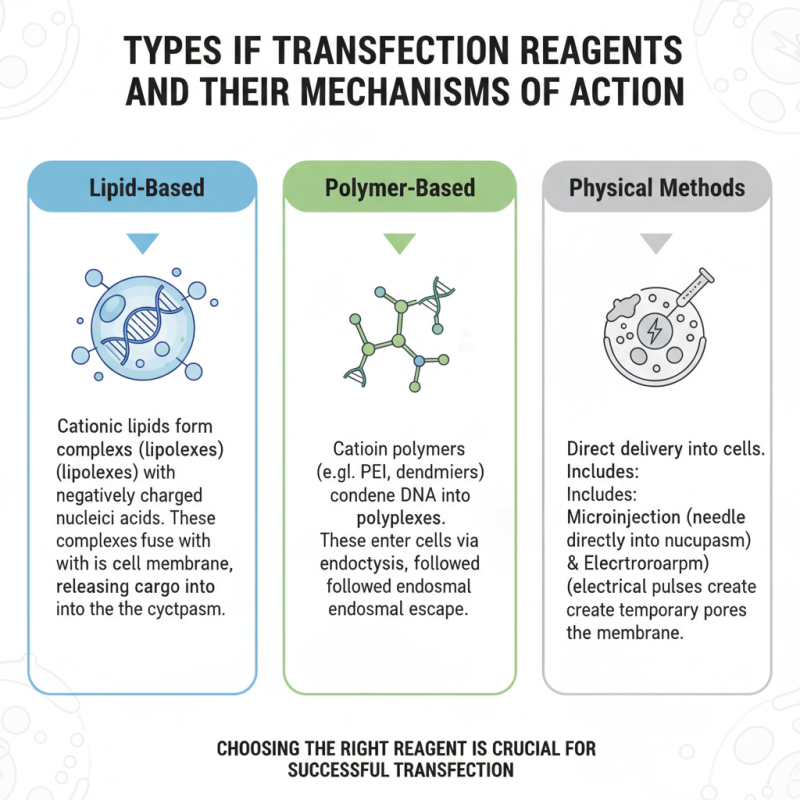
Types of Transfection Reagents and Their Mechanisms of Action
Transfection is a crucial process in molecular biology. Choosing the right transfection reagent can greatly impact your results. There are several types of transfection reagents, each with specific mechanisms of action.
Liposomes are commonly used. They encapsulate DNA in a lipid bilayer. This allows for easy entry into cells. However, the efficiency can vary with different cell types. For some cells, liposomes might not work well. Consider cell lines when choosing.
Polymer-based reagents are another option. They form complexes with DNA, aiding in cellular uptake. They often provide better delivery in hard-to-transfect cells. But, they may also induce a foreign body response. This can lead to unwanted effects in your experiments.
**Tips:** Always test a small batch before proceeding. Monitor cell viability and expression levels. If results are poor, rethink the reagent choice. Keep records of what works and what doesn’t. Adjust the protocol based on specific needs. Transfection efficiency can be unpredictable; learning through trial and error remains key.
Factors to Consider When Selecting Transfection Reagents
Choosing the right transfection reagents can significantly impact your experiments. Several factors should be considered during this selection process. One crucial factor is the type of cells you are working with. Different cell lines can respond differently to various transfection methods. Some cells are notoriously hard to transfect. Others may have high transfection efficiency. It's essential to match the reagent to your specific cell type.
Another factor is the desired gene expression level. Are you aiming for transient or stable expression? Transient transfection often requires less effort and reagents. Stable transfection might necessitate additional selection markers and prolonged culture time. Additionally, consider the scale of your experiment. High-throughput transfection can benefit from specialized reagents designed for large-scale applications.
Tips: Always review literature pertinent to your specific cells. It can provide insights into which reagents worked best. Don’t hesitate to perform a pilot experiment with different reagents. This can save time and resources in the long run. Remember, trial and error is part of the scientific process. Stay open to adjusting your approach based on initial results.
Assessing Reagent Performance: Efficiency and Toxicity
When selecting transfection reagents, evaluating their performance is crucial. Two primary factors come into play: efficiency and toxicity. Efficiency refers to how well these reagents deliver genetic material into cells. High efficiency is desirable. However, achieving that often leads to a trade-off.
Toxicity is another key consideration. Some reagents cause significant cell death. This negatively impacts the overall success of your experiments. Evaluating cellular health through assays can help identify toxic effects. A balance must be struck between efficiency and toxicity. It’s a fine line that requires careful monitoring.
Sometimes, even efficient reagents can induce unexpected responses in cells. Observing changes like morphology or growth rate is essential. These indicators can reveal underlying issues. Scientists should not ignore them. Reagent optimization often involves trials and errors. Be prepared to refine your choices based on specific cell types and experimental conditions.
How to Choose the Best Transfection Reagents for Your Experiments? - Assessing Reagent Performance: Efficiency and Toxicity
| Reagent Name |
Transfection Efficiency (%) |
Cell Viability (%) |
Time to Transfection (hours) |
Target Cell Type |
| Reagent A |
85 |
90 |
24 |
HEK293 |
| Reagent B |
75 |
85 |
16 |
CHO |
| Reagent C |
90 |
80 |
12 |
A549 |
| Reagent D |
80 |
70 |
18 |
MCF-7 |
| Reagent E |
78 |
88 |
20 |
U2OS |
Best Practices for Optimizing Transfection Protocols
Optimizing transfection protocols is crucial for effective gene delivery. Recent studies indicate that transfection efficiency can vary by as much as 50% depending on the chosen method. Key factors such as cell type, nucleic acid composition, and reagent compatibility play significant roles. Adjusting these parameters can improve outcomes significantly.
One common pitfall is overlooking cell confluency. Many researchers aim for 70-80% confluency, yet results show that 50-60% can yield better transfection rates in some cell lines. Another critical consideration is the incubation time during transfection. While standard durations range from 24 to 72 hours, fine-tuning this variable could enhance expression levels.
Moreover, the optimization process is often iterative. What works for one experiment may not hold true for another. This variability requires continual assessment and adjustment. Keeping detailed records allows researchers to reflect on past experiments and refine their techniques. Data-driven decisions often lead to improved protocol outcomes over time.