BioIVT ADMET Solutions

BioIVT offers a comprehensive range of ADMET products designed to support drug discovery and development. From in vitro ADME assays to toxicology testing solutions, our high-quality biological materials and services enable researchers to evaluate absorption, distribution, metabolism, excretion, and toxicity with accuracy and efficiency.

circle-clipart

Diverse Range of Products

Cells and Tissues from Human / Animal Liver, Lung, Kidney, Intestine and Others
circle-clipart

Stock in Mumbai

View the detailed list of ADME tissues and fractions in stock currently.
circle-clipart

Quality

Our high-quality biospecimens come with an unconditional product guarantee.
BioIVT is the worldwide leader of biological ADMET-products to life sciences and pharmaceutical companies. 

As the leading provider of human and animal hepatocyte products, BioIVT offers high-quality cells with the most characterization and the largest lot sizes in the industry.


BioIVT Cells and Fractions have:

  • Large lot sizes available
  • Extensive inventory (in Mumbai and in the US)
  • High viability and consistency
  • Proprietary technologies for higher quality products
  • Specialized test systems
  • Supply chain infrastructure with Krishgen and BioIVT working together to ensure cold chain maintanence

Product Types Available

Tissue and Sub-cellular Fractions

Non-Traditional Sub-cellular Fractions
Cryopreserved Hepatocytes

Recombinant Cytochrome P450 Enzymes
Non-Cyp Recombinant Enzymes

How to Choose the Right Test Systems for Your DMPK Studies

Tissue Sub-Cellular Fractions

BioIVT produces subcellular fractions through the process of subcellular fractionation, which is the separation of cellular components. The initial step starts with the homogenization of tissue in an isotonic buffer to aid in the separation of the cellular components.

Through differential centrifugation, BioIVT can isolate purified organelle fractions including:

Used in western blotting, protein binding, enzyme assays and matrix controls to determine if enzyme activity is important for your study.
Learn More.

Microsomes are valuable tools in drug discovery for studying the metabolism of your compounds.
Learn More.

A diverse range of products derived from human liver, lung, kidney, intestine, and skin tissues.
Learn More.

Used in drug development as predictive test systems to evaluate specific drug-metabolizing enzymes that are highly expressed in certain cellular compartments / organelles.
Learn More.

Preparations from liver cells are used in drug development as predictive test systems to evaluate specific drug-metabolizing enzymes that are enriched in certain cellular compartments / organelles.
Learn More.

BioIVT’s standard products feature fully-characterized subcellular fractions from the following toxicologically-relevant species:

Human

Rat/Mouse

Rabbit

Monkey

Mini Pig

Hamster

Guinea-Pig

Dog

Non-Traditional Sub-Cellular Fractions

BioIVT offers non-traditional sub-cellular fractions to support advanced drug metabolism and pharmacokinetic (DMPK) studies. These specialized fractions, from various species, enable researchers to investigate enzyme activity, metabolic stability, and reaction phenotyping with greater flexibility and precision.

Used in western blotting, protein binding, enzyme assays and matrix controls to determine if enzyme activity is important for your study.
Learn more

Microsomes are valuable tools in drug discovery for studying the metabolism of your compound
Learn more

Used in drug development as predictive test systems to evaluate specific drug-metabolizing enzymes that are highly expressed in certain cellular compartments / organelles.
Learn more

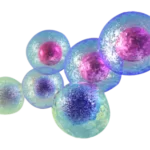
Cryopreserved Hepatocytes

Purified frozen liver cells that can be thawed and cultured in a lab. Hepatocytes are the main structural and functional parenchymal cells of the liver. 

They make up approx. 80% of the liver, but only 60% of the total liver cells. 

Hepatocytes express high levels of transporters and drug metabolizing enzymes (DMEs).

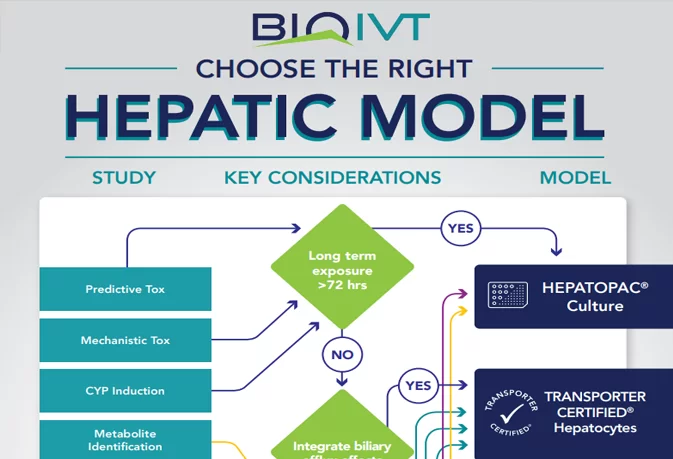
Select the Right Hepatocytes for Your Study

Which in vitro test system best suits my needs?

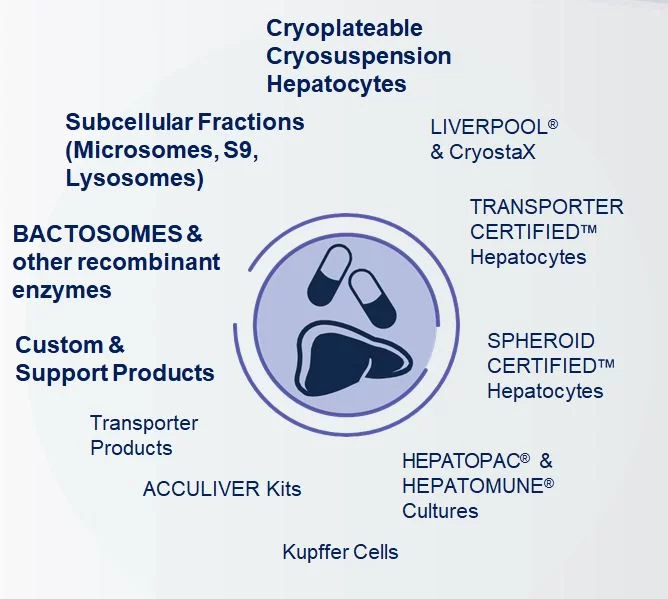
We offer a wide variety of hepatocyte test systems. We can provide immortalized or primary cells, fresh or cryopreserved, animal or human hepatocytes in the format of your choice. We have individual donor and pooled donors, suspension and plateable cells, and can even plate the hepatocytes for you.

Choose quality human cryoplateable hepatocytes from BioIVT.

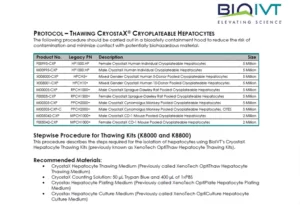
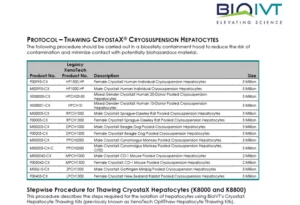
For short-term assays, individual, LIVERPOOL® and Cryostax® human cryosuspension hepatocytes are available.

Learn more

Freshly isolated hepatocytes are offered from human, rat, dog, monkey and mouse.

Learn more

For long-term assays, check out the extensive offering of animal cryoplateable hepatocytes.

Learn more

For short-term in vitro studies, view our extensive animal cryosuspension inventory of preclinical species.

Learn more

Hepatocytes from the immortalized Fa2N-4 cell line maintain near-normal morphology in culture, suitable for induction screening and lysosomal trapping assays.

Learn more

BioIVT offers an extensive catalog of recombinant CYPs and purified enzymes, including all the CYPs typically investigated in drug discovery programs.

A comprehensive range of human CYPs co-expressed with human NADPH CYP-reductase with or without human cytochrome b5. The CYPs are available with high or low levels of reductase relative to the CYP, allowing you to choose products that fit your assay.
High Reductase Bactosomes exhibit higher activity but the time for which the reaction is linear is shorter;
Low Reductase Bactosomes have a lower activity but the reaction is linear for longer.

BioIVT also has introduced ranges of animal equivalents for use in the development of veterinary medicines. These include:

Recombinant CYP BACTOSOMES®: Versatile Formats for Many ADME Applications

Recombinant cytochrome P450 (rCYP) enzymes are commonly used in ADME-Tox studies as in vitro tools, mostly for reaction phenotypingenzyme inhibition screening, clearance and metabolite ID.

Non-CYP Recombinant Enzymes:

BioIVT provides non-CYP recombinant enzymes for reliable in vitro studies of drug metabolism and biotransformation. These high-quality enzymes support research on phase I and phase II metabolic pathways, enabling precise evaluation of compound stability, metabolite profiling, and potential drug-drug interactions.

Cell Selection, Handling & Media Tips to Get the Best Results from Your Hepatocyte Assays

Stock Availability in the Mumbai Warehouse

This stock may have discrepancies as it is not updated in real time. Please get in touch with our team before placing your final order.

Human Liver Microsomes
Animal Liver Microsomes
Animal S9 Fractions
Human Hepatocytes
Animal Hepatocytes
Animal Liver Microsomes

The above stock represents ADME tissues and enzymes available with us in Mumbai. In case you are looking for plasma, sera or other CGT products, please view our CGT page here.

Stock Availability in the Mumbai Warehouse

This stock may have discrepancies as it is not updated in real time. Please get in touch with our team before placing your final order.

Human Liver Microsomes
Animal Liver Microsomes
Animal S9 Fractions
Human Hepatocytes
Animal Hepatocytes
Animal Liver Microsomes
Cytosol
Human S9 Fractions
CYPs
Others (Lysosomes, Plasma, Homogenates etc)

The above stock represents ADME tissues and enzymes available with us in Mumbai. In case you are looking for plasma, sera or other CGT products, please view our CGT page here.

More About In Vitro Hepatocyte Models

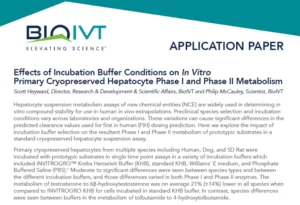
Improving In Vivo Predictions from In Vitro Hepatocyte Models

Abstract: In both in vitro systems and in vivo, it is the unbound intracellular concentration (ICC) that is the driving force for processes that occur inside the hepatocyte. Achievement of an in vivo relevant ICC requires a polarized whole-cell system that integrates uptake into the hepatocyte, metabolism, and efflux (basolateral and canalicular) from the hepatocyte. Extensive protein binding can limit the uptake of many drugs, however for some drugs the estimation of intracellular concentration, and hepatic clearance cannot be correctly predicted based on the free (unbound) drug concentration. Additionally, studies have shown that transporters can be upregulated similar to metabolic proteins, resulting in increased uptake and/or efflux. Use of polarized whole-cell models and optimized culture conditions for in vitro systems may improve predictions of a drug’s in vivo properties and effects.

Flyers and Product Guides

Latest Blogs

Need More Information?

The Krishgen support team strives to provide swift responses and resolution to your queries. Get in touch for a technical question, product query or quote request.